%20(1).png)
The Psychology of a Perfect Snooker Shot: How Champions Stay Calm Under Pressure
Snooker is often described as a game of geometry, precision, and mechanics—but at its highest level, it is a contest of the mind far more than a contest of cue action. Every player, whether amateur or professional, knows the feeling: your palms tighten, your heart rate climbs, and a simple pot suddenly becomes a mountain. And yet, the champions—Ronnie O’Sullivan, Mark Selby, Judd Trump, John Higgins—seem to glide through these moments with an almost supernatural calm.
So what makes the difference?
How does one execute the perfect snooker shot not just mechanically, but psychologically—especially under pressure?
This article explores the science, sports psychology, and lived experiences of top snooker players to reveal exactly how champions keep their nerves in check and perform at the highest level.
1. The Mind Behind the Cue: Why Psychology Determines Precision

A perfect snooker shot isn't just about striking the cue ball cleanly—it’s the sum of:
visual accuracy
motor control
emotional regulation
confidence
concentration
decision-making
Research in sports psychology shows that the brain processes high-precision motor tasks differently under pressure. Anxiety can cause:
muscle tightening
narrowed vision
overthinking
misjudged cue-ball contact
rushed execution
In snooker, the margin for error is microscopic. A slight tension in the grip or a small shift in breathing alters cue delivery.
This is why mental stability, more than cue technique, separates the good from the truly great.
2. The Flow State: The Secret to Executing the Perfect Snooker Shot

Most champions describe their best moments as “automatic.”Sports psychologists call this the flow state.
Flow occurs when:
skills match the challenge
the mind is fully present
self-doubt quietens
the player becomes absorbed in the task
Ronnie O’Sullivan has frequently said that his best snooker feels like he is “not trying at all.” Mark Selby, a master of grinding mental play, says he enters “tunnel mode,” where only the shot exists.
The flow state is critical in producing the perfect snooker shot, because:
movements become smooth and repeatable
anxiety drops
decision-making sharpens
timing improves automatically
Learning how to enter flow on demand is one of the key mental advantages of champions.
3. How Professionals Manage Pressure: Lessons from the Greats

a. Ronnie O’Sullivan – Trust the Process
Ronnie is known for his speed, but the real key is trusting his natural mechanics.When under pressure, he avoids overthinking and relies on instinct.
Mental tactic: Reduce cognitive overload → let the body do what it’s practiced.

b. Mark Selby – Slow the Game Down
Selby is famous for absorbing pressure by controlling tempo.He plays to regain composure, forcing the mind back into stability.
Mental tactic: Use tempo as emotional regulation.

c. Judd Trump – Positive Framing
Trump has spoken about shifting from fear-driven snooker to enjoyment-driven snooker in 2019, the year he won the World Championship.
Mental tactic: Replace fear of failure with excitement for opportunity.
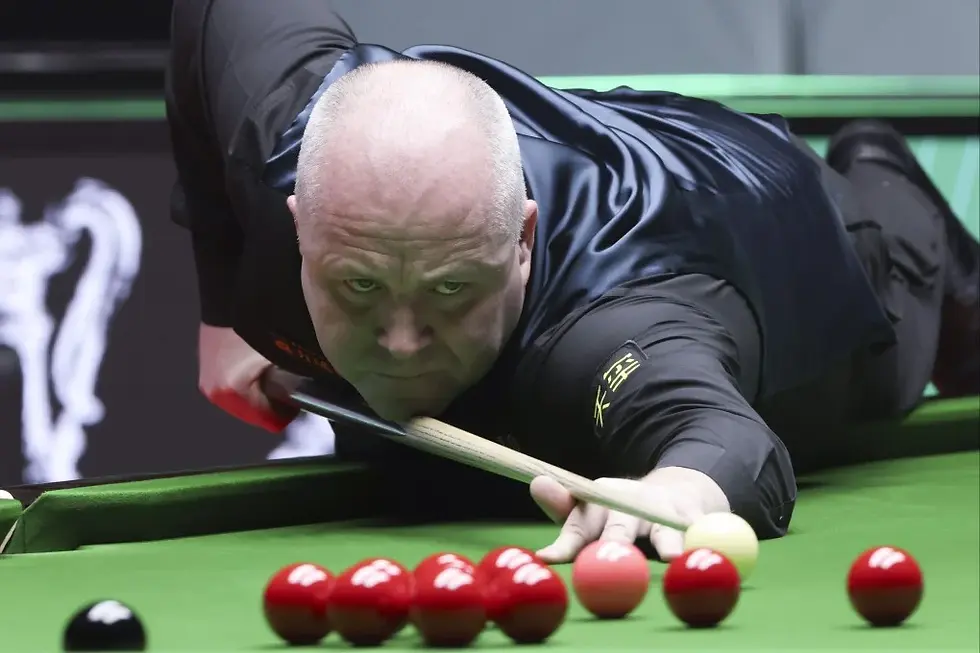
d. John Higgins – Micro-Routine Discipline
Higgins’ calm stance and familiar pre-shot routine reduce pressure by removing variables.
Mental tactic: Rituals neutralize anxiety.
Champions don’t avoid pressure—they manage it. This is the real psychology behind a perfect snooker shot.
4. Pre-Shot Routine: The Mental Algorithm of Champions

A pre-shot routine is the most essential psychological tool for consistency.
A strong routine usually includes:
Assessing the table(patterns, angles, cannon risks, position zones)
Choosing a clear shot(no second guessing once committed)
Visualizing the pot and cue-ball travel(champions often mentally “feel” the shot before hitting it)
Breath regulation(smooth exhale before final backswing)
Physical settling(shoulders drop, grip relaxes, head anchors)
Execution with trust
This routine acts like a mental anchor. Even when adrenaline spikes, the structure remains the same—resulting in a stable shot-making process.
Players who lack a routine often crumble when pressure increases because their mind becomes chaotic.
5. The Role of Breathing and Heart Rate in Executing the Perfect Snooker Shot

Snippet from physiological studies on precision sports:
When heart rate exceeds 120 bpm, motor precision drops significantly.
Slow breathing reduces heart rate and stabilizes hand movement within seconds.
Snooker champions use breathing techniques subconsciously:
Box Breathing (4-4-4-4)
inhale 4 seconds
hold 4
exhale 4
hold 4
Long Exhale Method
This technique is key for the perfect snooker shot:
inhale 3 seconds
exhale 6 seconds
A long exhale activates the parasympathetic nervous system, calming the body immediately.
This is why many pro players pause briefly before committing to the final cue action: they’re regulating their physiology.
6. Visualization: The Most Underrated Skill in Snooker Psychology

Visualization is not imagination—it is simulated rehearsal.MRI studies show that imagining a movement activates nearly the same neural pathways as performing it.
Top players visualize:
the path of the object ball
cue-ball deflection and spin
bounce off cushions
finishing position
This mental rehearsal primes the brain for successful execution.
A perfect snooker shot is often hit before the cue even moves—it was already created in the player’s mind.
7. Pressure Situations: Why the Brain Sabotages Good Technique
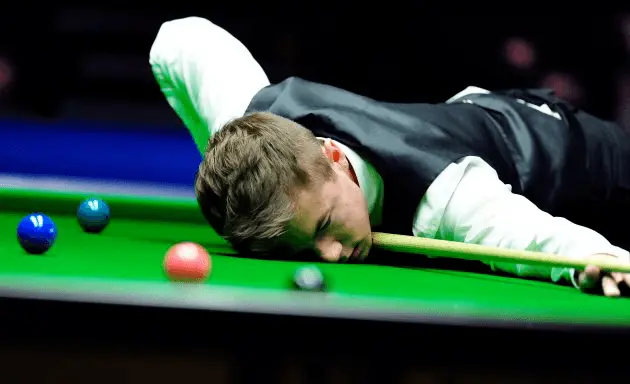
When stakes are high—the final black, a frame-winning red, or a match-deciding long pot—the brain enters “threat mode.”
This triggers:
adrenaline release
increased muscle tension
impulsive decision making
visual narrowing
This is why players sometimes miss an easy ball under pressure.
Choking vs. Clutch Performance
Two reactions to pressure:
Choking: Too much focus on mechanics → overcontrol → miscue
Clutch performance: Enhanced focus + trust → precision increases
The difference is psychological training.Champions build clutch performance over years of conditioning.
8. Emotional Regulation: How Champions Stay Unshakable

Snooker is emotionally brutal.One mistake can cost a frame, a match, or a title.
Champions develop emotional neutrality:
They don’t over-celebrate wins.
Because emotional spikes disrupt rhythm.
They don’t dwell on mistakes.
Because that increases cognitive load.
They stay present, not future-focused.
The only shot that matters is the next shot.
Mark Selby’s mental resilience is a prime example; even after losing multiple frames, he can mentally reset instantly.
9. Concentration: The Fuel Behind the Perfect Snooker Shot

Focus in snooker is like a battery—it drains with every decision, every safety exchange, and every long frame.Champions understand their attention cycle.
How players maintain concentration:
short mental breaks between frames
mini resets after complex shots
maintaining physical relaxation
avoiding emotional spikes
controlled hydration and glucose levels
The mind and body must remain in sync.
Without concentration, even the best technique cannot produce the perfect snooker shot.
10. Confidence and Self-Belief: The Invisible Advantage

Confidence in snooker is not arrogance; it is predictive self-trust.
Studies show that confident players:
decide faster
visualize better
execute smoother cue action
show less muscular tension
Confidence creates mechanical fluidity.
A perfect snooker shot is therefore often a confident shot.
How champions build confidence:
reviewing past successes
trusting practice
avoiding negative internal dialogues
framing pressure as opportunity, not threat
Judd Trump’s post-2019 transformation is a textbook case of confidence evolution.
11. Body Language and Posture: The Psychology of Physical Presence
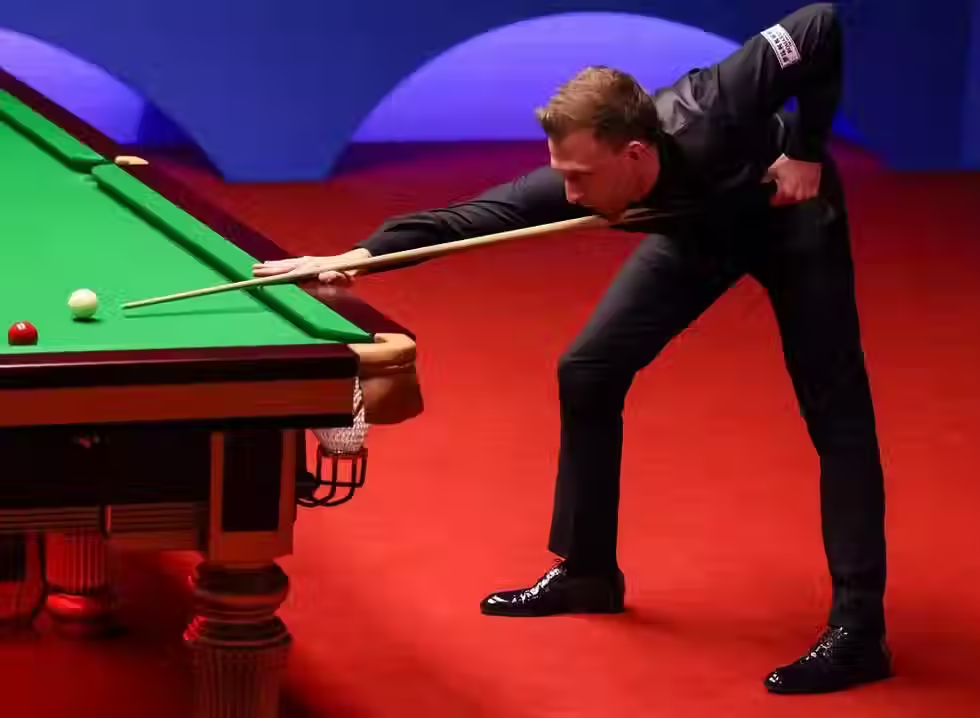
Players’ posture reveals their mental state.
Positive posture improves breathing, stability, and focus:
relaxed shoulders
loose grip
slow walkaround
Even eye movement matters—pros keep their gaze low and steady, as wandering vision indicates distraction.
A consistent, poised physical presence helps maintain mental control.
12. Decision-Making: Choosing the Perfect Snooker Shot Under Pressure

Great players simplify the table.
They mentally run through:
risk vs reward
angle consistency
scoring opportunities
escape routes
long-term frame strategy
In pressure moments, poor decision-making—not poor cueing—is the main cause of failure.
Champions commit to one thought, one decision, one shot.
Indecision is the enemy of precision.
13. Practice Habits That Build Mental Strength

To perform perfectly under pressure, players must replicate pressure during practice.
Common drills include:
a. Pressure Colors Drill
Potting colors in sequence where a miss ends the routine.
b. Line-Up with Consequences
Restart the line-up completely if one ball is missed.
c. Time-Restricted Break Building
Improves decision-making and instinctive play.
d. Tournament Simulation Practice
Players practice as if they are in a live match—scored, timed, and strict.
These drills create mental familiarity.Pressure becomes normal—not extraordinary.
14. How Amateurs Can Train Their Mind for the Perfect Snooker Shot
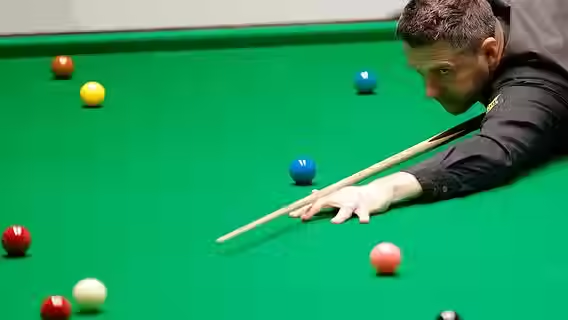
Even club players can massively improve mental consistency:
Develop a simple pre-shot routine
Visualize every pot before striking
Use breathing control during pressure moments
Stay emotionally neutral—good or bad shot
Practice under self-created pressure
Slow everything down when nerves increase
The perfect snooker shot is not about natural talent—it is about repeatable psychology.
FAQ Section
1. What is the biggest psychological factor in making the perfect snooker shot?
Consistency in pre-shot routine and emotional regulation. When a player performs the same sequence every time, the mind stabilizes and nerves fade.
2. How do professional players stay calm during high-pressure moments?
They use breathing control, visualization, and mental reset techniques. Champions also view pressure as an opportunity rather than a threat.
3. Does anxiety really affect cue action?
Yes—studies show anxiety increases muscle tension, which distorts cue delivery. Even minor tension can ruin a precision shot.
4. How can amateurs improve mental strength in snooker?
By practicing with pressure-based drills, using a consistent routine, slowing down breathing, and mastering table assessment decision-making.
5. Can visualization really improve snooker performance?
Absolutely. Visualization activates the same neural pathways used in shot execution, making movements more natural and accurate.
6. Why do players miss “easy shots” under pressure?
Because the mind focuses on the outcome instead of the process. This overthinking disrupts fluid cue action.
7. Is confidence more important than technique?
You need both, but confidence enhances technique. The more a player trusts themselves, the more fluid and accurate their cue action becomes.
Author Bio:

Dr. Robin Alexander is an MD Pathologist, passionate guitar enthusiast, and lifelong snooker fan. He combines medical precision with a love for music and sport. Connect with him on LinkedIn.

Comments